

Social calls of the Pond bat (Myotis dasycneme)
Recordings from 2024 to 2026
These type A, B and C social calls were recorded when at least 425 individual pond bats were counted emerging from their maternity roost.





These type C social calls were recorded near a big waterway. They are emitted by a pond bat that was showing defensive behavior towards another pond bat emitting regular echolocation calls. For pond bats, these calls may be warning calls made when other trawling bats are around at times when prey is less available and/or in order to protect a good hunting area (Middleton et. al., 2022).

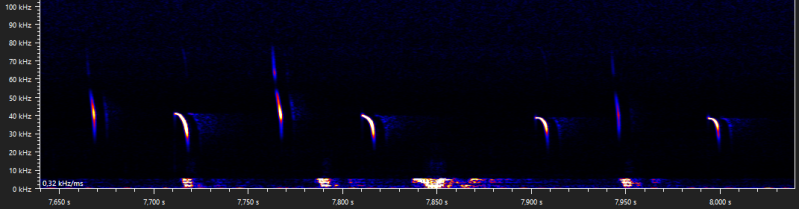
Date of recording: 2024-06-06 Recorded by: Anice Hut Audio file: 911253
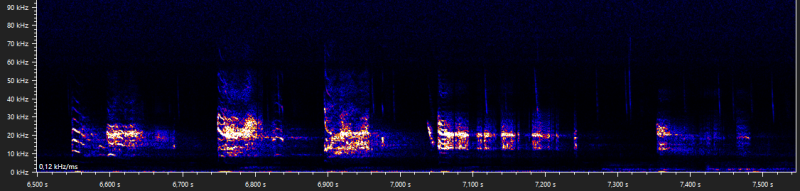
These series of FM calls (underneath the echolocation of the Nathusius' pipistrelle in the first snippit) were twice during the same night (at 23:37 and 00:06) and show a lot of similarity with a feeding buzz. Marc van de Sijpe stated that he would be surprised if calls like these would have a sole echolocation function of prey approach and capture and that it would not be surprising if these calls are aggresive calls as a reaction to kleptoparasitism - when another animal wants to steal the prey (Neil Middleton, et al., 2022).


More type B social calls were recorded by three different people on the same survey site on different moments during the same evening. Type C social calls, in the shape of walking sticks, are present between two buzzes in the last snippit (just after 11,600s in the recording).


Not entirely sure of the identification of this recording, but the buzzing looks similar to pond bat and the echolocation seems to morph into regular echolocation calls near the end of the recording. Also note the upward hook at the end of the call around 1,080s in the recording (see the zoomed-in snippit on the right).


Date of recording: 2025-05-13 Recorded by: Sarah Mahie Audio file: 1003591
These social calls were recorded in the vicinity of a roost:


Date of recording: 2025-06-14 Recorded by: Sander Boersma Audio file: 1006703
These type A, B and C social calls were recorded in the vicinity of a maternity roost:


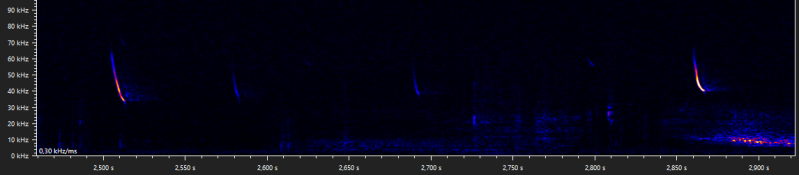
Between regular pond bat echolocation calls, at 2,625s and 2,800s in the recording, two calls appear at a frequency of 57 kHz. The echolocation calls of a soprano pipistrelle would be very coincidental (but not impossible). However, two type C social calls is probably more likely.
All recordings are licensed under the following Creative Commons Attribution-NonCommercial-NoDerivs 4.0 license and in courtesy of Sarah Mahie.
All the original video footage can be found on our Youtube channel: United by Ecology
All sonograms are screenshots of the recordings imported in the ultrasound analysis software BatExplorer 2.2 (Elekon, Switzerland).
Bibliography:
- Neil Middleton, Andrew Froud and Keith French (2022). Social Calls of the Bats of Britain and Ireland (second edition). Pelagic Publishing.
Create Your Own Website With JouwWeb