

Feeding buzzes of bats in the Netherlands
And read about drinking buzzes at the end of this page.
Common noctule (Nyctalus noctula)
Rosse vleermuis

Above: Recorded by: Nanieke van den Berg Audio file: 911316
Under: Recorded by: Gijs Peters Audio file: 918947

Leisler's noctule (Nyctalus leisleri)
Bosvleermuis

Recorded by: djsaaltink Audio file: 809838
Serotine bat (Eptesicus serotinus)
Laatvlieger

Above: Recorded by: Charlotte Serrarens Audio file: 920292
Under: Recorded by: Romee Bleijenberg Audio file: 910954

Soprano pipistrelle (Pipistrellus pygmaeus)
Kleine dwergvleermuis
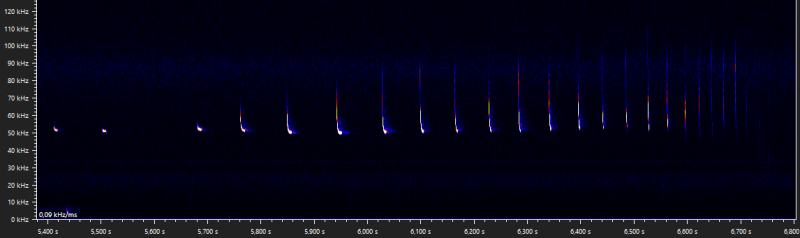
Above: Recorded by: Sarah Mahie, Boaz van Die Audio file: 1138201
Below: Recorded by: Sander Boersma, Sarah Mahie Audio file: 1156180

More: 1138208
Common pipistrelle (Pipistrellus pipistrellus)
Gewone dwergvleermuis
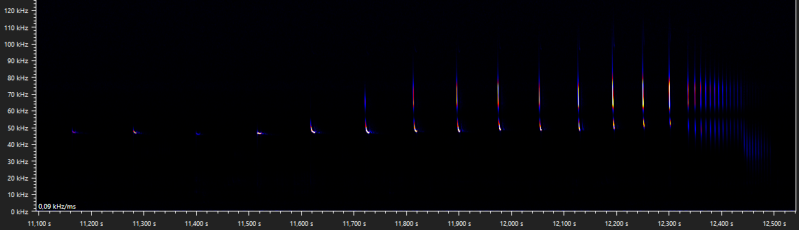
Above: Recorded by: Jasper Geukemeijer Audio file: 931826
Under: Recorded by: Charlotte Serrarens Audio file: 910969
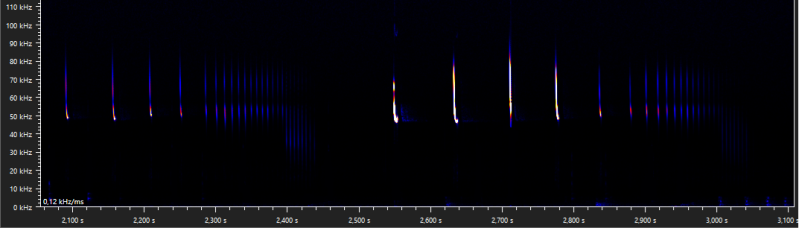
Nathusius pipistrelle (Pipistrellus nathusii)
Ruige dwergvleermuis
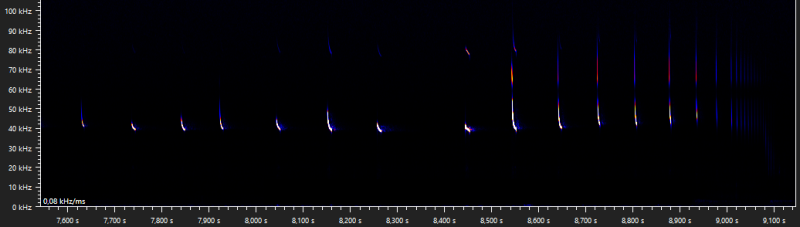
Above: Recorded by: Sjoerd Luykx Audio file: 911004
Under: Recorded by: Jasper Geukemeijer Audio file: 911314
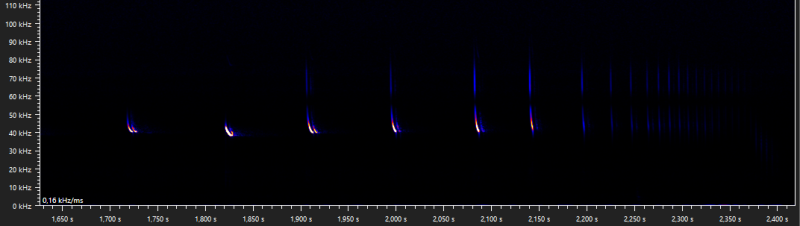
Pond bat (Myotis dasycneme)
Meervleermuis
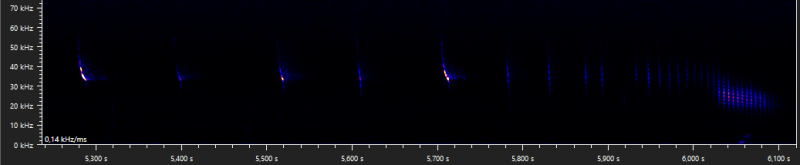
Above: Recorded by: Abe-Jan van der Wal Audio file: 915031
Under: DRecorded by: Nathan Krijnen Audio file: 911008

Daubenton's bat (Myotis daubentonii)
Watervleermuis
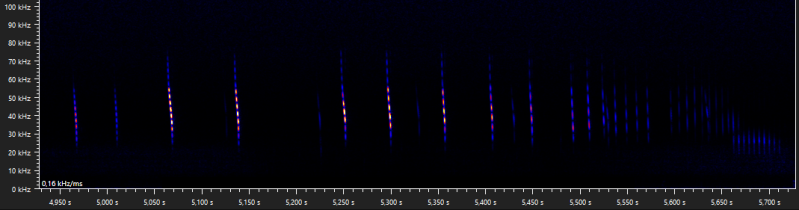
Above: Recorded by: Abe-Jan van der Wal Audio file: 911006
Under: Recorded by: Thomas Maris Audio file: 919820
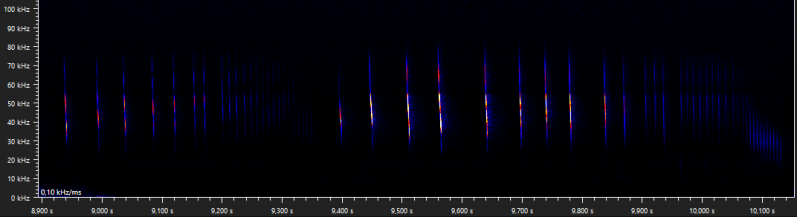
Feeding without buzz
Sometimes, bats may use their hearing alone to locate an insect, without echolocation calls. Such hunting strategy is known from long-eared bats and the greater mouse-eared bat. When this happens, no typical feeding buzz occurs. When these bats prey on beetles, crunching sounds of the bat chewing can be heard after their catch.
First, an example of a beetle caught with a typical feeding buzz, the audible chewing alternated with echolocation calls:
Serotine bat (Cnephaeus serotinus)
Laatvlieger

Recorded by: Arjan Boonman Audio file: 937312
No feeding buzzes have been recorded of the greater mouse-eared bat in Twente, whereas similar crunching-sounds inbetween echolocation calls are documented:
Greater mouse-eared bat (Myotis myotis)
Vale vleermuis
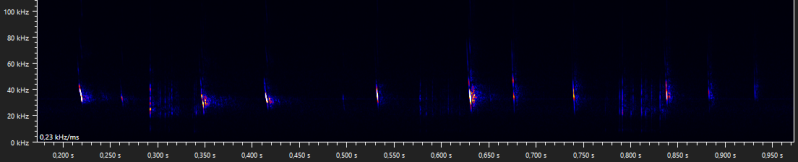
Recorded by: Léon Leijdekkers Audio file: 358202186
Drinking buzzes
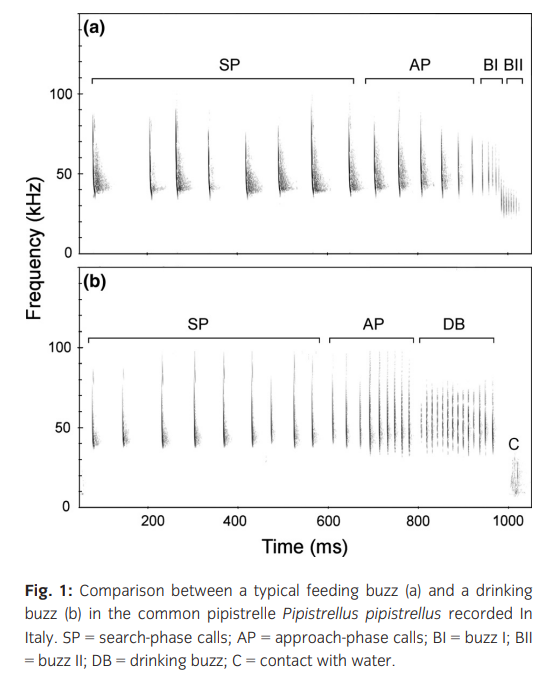
Bats also produce buzzes when drinking water. These kind of buzzes haven't received a lot of attention so far as they are often being interpreted as (aborted) feeding buzzes. However, drinking buzzes differ significantly from feeding buzzes.
A regular feeding buzz starts with an increase of the inter-pulse interval (phase I) and proceed to lower the pulses in frequency (phase II). Drinking buzzes are most similar to phase I of a feeding buzz, since the inter-pulse interval increases but the full buzz doesn't result in lowering the frequency of the pulses near the end. Drinking buzzes have a longer inter-pulse interval than phase II of a feeding buzz, and in most cases also phase I. Most bats quit echolocating for some time before contacting water and since breathing is inhibited during swallowing, no echolocation occurs at the same time as the actual drinking.
The authors of the cited study believe that the most plausible explanation for the occurrence of drinking buzzes is that this is a generalized pattern used to guide a safe drinking manoeuvre, similar to ‘landing buzzes’ produced by bats soon before landing on the ground. It still needs to be studied if a significant difference occurs in terminal buzz structure between drinking and landing events.
Information and image source: Danilo Russo, Leonardo Ancillotto, Luca Cistrone & Carmi Korine (2015). The Buzz of Drinking on the Wing in Echolocating Bats. Ethology 112(3): 226-235. DOI
Create Your Own Website With JouwWeb