

Social calls of the Soprano pipistrelle (Pipistrellus pygmaeus)
Recordings from 2020 to 2026
The following snippits contain type (A,) B, C and D social calls emitted from within the maternity roost after a soprano pipistrelle entered. The last snippit shows unusual upward-sloping echolocation of this species (Russ, 2021).
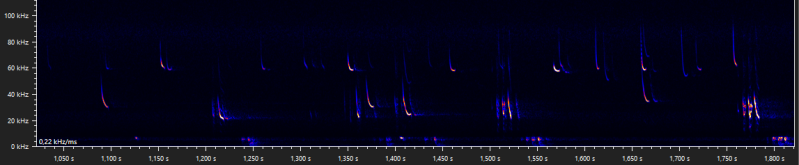
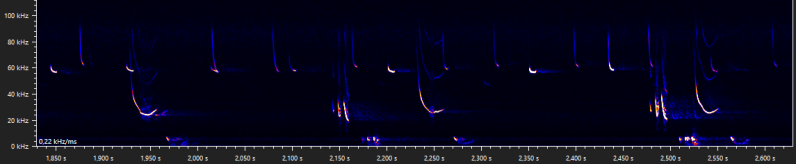
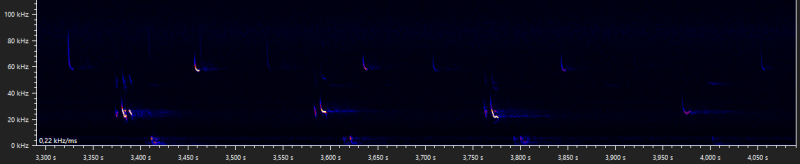
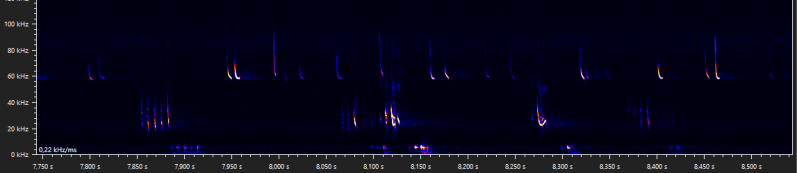

These type C social calls in the first row of snippits were recorded while soprano pipistrelles were leaving their maternity roost. The type D social calls, their typical 3-component variants, in the second row of snippits were recorded on forest paths nearby the roost.
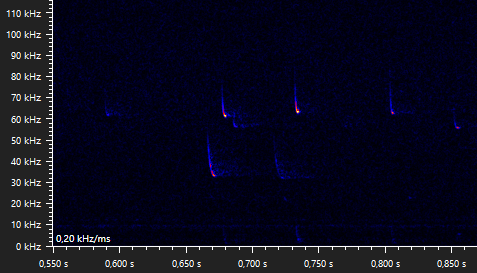
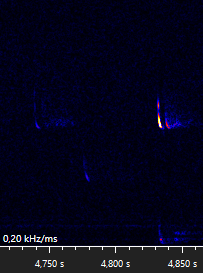
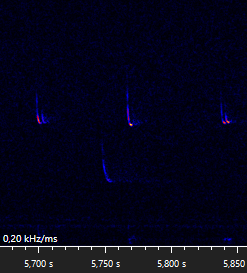
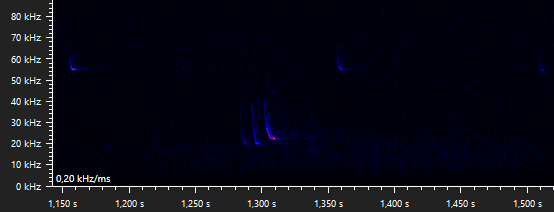
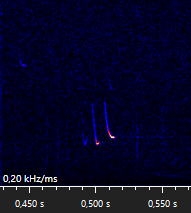
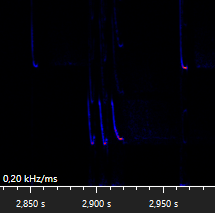
Date of recording: 2020-05 Recorded by: Zoogdierenwerkgroep Zuid-Holland Audio file: Download here
The following type C social calls (the first three snippits) were recorded in the vicinity of the maternity roost and the type D social calls (the last, fourth, snippit) was recorded in a different area, close to forest, though still nearby the roost.
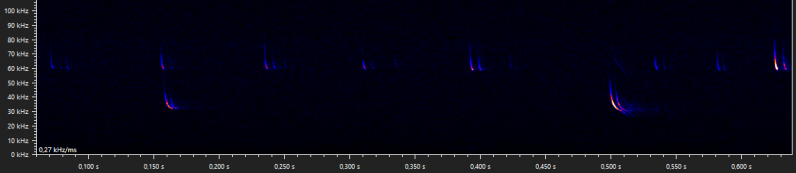


The following example is an advertising male, emitting type D social calls while in flight. Fourteen social calls are present in the recording.


Date of recording: 2024-09-20 Recorded by: Sjoerdtje de Boer Audio file: 1008590
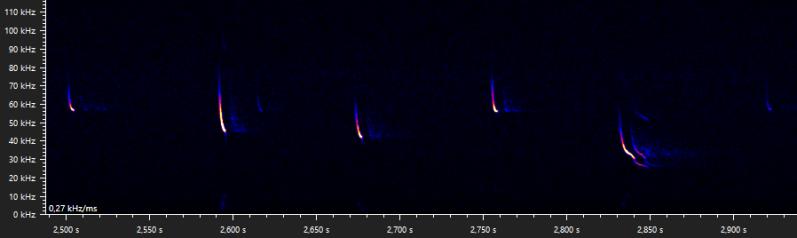
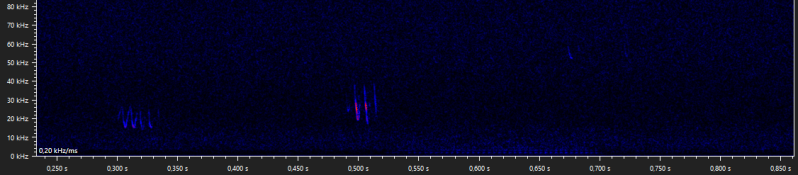
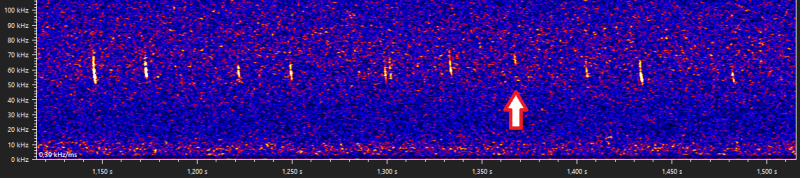
A year later at the same location as the previous recording, an advertising male was recorded again. This time a few 4-component variants of the social call were pesent as well along side their ususal 3-component variants. A social call that was partially joined-up was also recorded.


The first snippit shows a type D social call with all components joined-up, forming a trill. The second snippit shows what appears to be a high-frequency type C social call.
Date of recordings: 2025-06-22 Recorded by: Sarah Mahie Audio files: 1008689
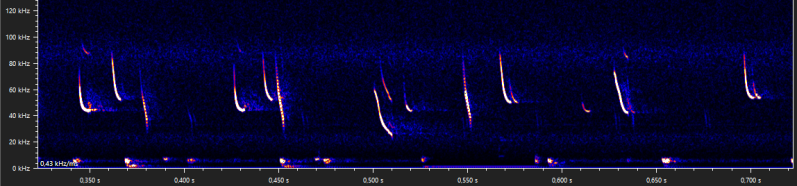
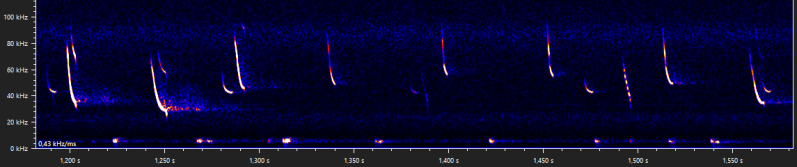
Echolocation calls of the Daubenton's bat and common pipistrelle are also present in the following recordings. These type C (first two snippits) and type D (last four snippits) social calls were recorded near a lake where the bats of a known maternity colony were foraging. The type D social calls of the soprano pipistrelle can be differentiated from the common pipistrelle by their higher end frequency, which is around 20 kHz.
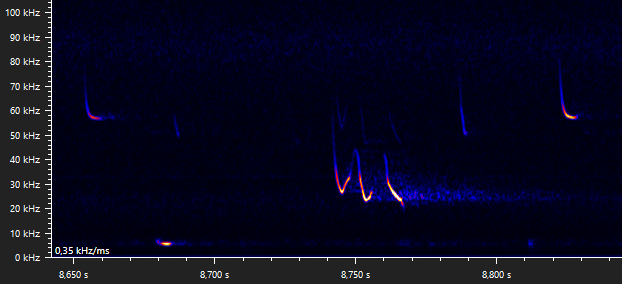
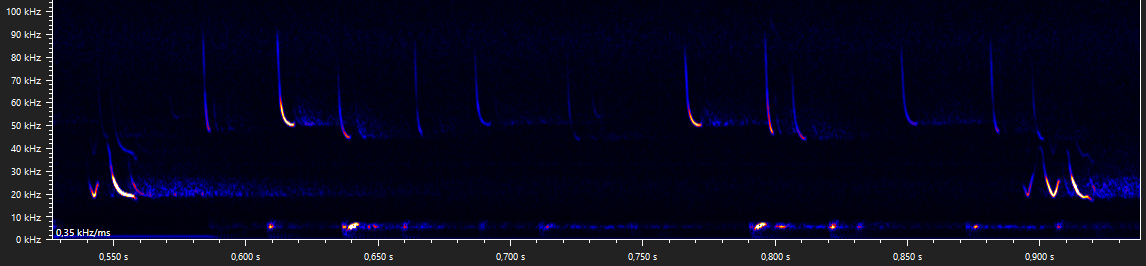
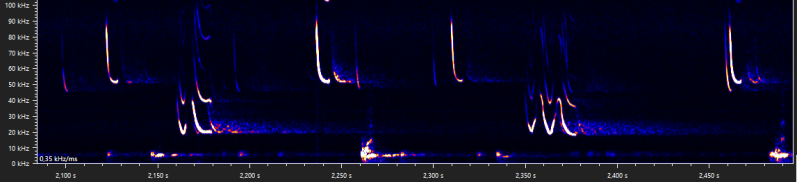
All recordings are licensed under the following Creative Commons Attribution-NonCommercial-NoDerivs 4.0 license and in courtesy of Sarah Mahie.
All sonograms are screenshots of the recordings imported in the ultrasound analysis software BatExplorer 2.2 (Elekon, Switzerland).
Bibliography:
- Jamaul, R. & Barataud, M. (2018). GraphB v1.8. http://geoeco.fr/ecologie_acoustique/en/appli_graph
- Neil Middleton, Andrew Froud and Keith French (2022). Social Calls of the Bats of Britain and Ireland. Second edition. Pelagic Publishing.
- Jon Russ (2021). Bat Calls of Britain and Europe: a Guide to Species Identification. Pelagic Publishing.
Create Your Own Website With JouwWeb